
Supplementing retirement income
Creating additional flexibility for regular living costs or expenses later in life.
Reverse Mortgages
Understand how reverse mortgages and equity release work, what may be available, the costs and risks involved, and the alternatives worth comparing before making a decision.
Last reviewed
A reverse mortgage is a loan that allows an eligible homeowner to access part of the equity in their home without making regular repayments in the same way as a traditional mortgage.
The amount borrowed, together with interest and applicable fees, is generally added to the loan balance over time. The loan is usually repaid when the property is sold, the borrower permanently leaves the home, or another repayment event occurs under the loan agreement.
Because the balance can increase over time, it is important to understand not only how much may be available today, but also how the loan could affect the equity remaining in the property later.
A reverse mortgage can be considered for many different reasons. The important question is not simply whether funds are available, but whether using home equity makes sense for the circumstances.
Creating additional flexibility for regular living costs or expenses later in life.
Funding repairs, accessibility improvements or changes that may make it easier to remain at home.
Reducing or restructuring other debts where this forms part of an appropriate broader lending strategy.
Helping meet accommodation or care-related costs after considering the available funding choices and alternatives.
Providing financial assistance to adult children or other family members while considering the homeowner's own future needs.
Helping fund a move, retirement accommodation or another housing transition.
In some circumstances, released equity may assist with transitional housing, relocation or purchasing a smaller replacement property, subject to property settlement, ownership and lender requirements.
Creating access to funds for unexpected future expenses rather than necessarily drawing the full available amount immediately.
The amount potentially available depends on several factors, including the age of the borrower, the value and location of the property, the type of property, existing debt and individual lender policy.
Reverse mortgage borrowing limits generally increase with age. Different lenders can also apply different lending policies, which means the amount available may vary materially from one lender to another.
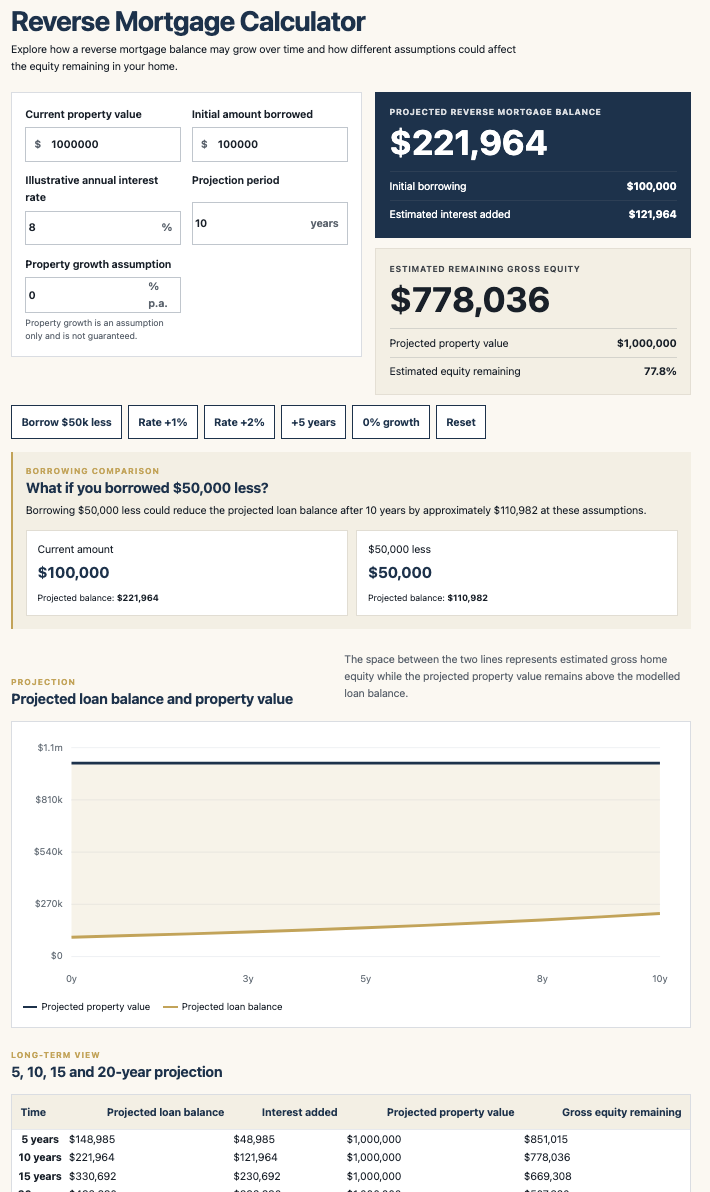
Reverse Mortgage Calculator
Explore how different borrowing amounts, interest rates and time periods may affect the projected loan balance and the equity remaining in the property.
The calculator lets you test different scenarios before deciding whether a reverse mortgage is worth investigating further.
Change the amount borrowed
See the effect of borrowing more or less.
Compare different time periods
Explore how the balance may change over 5, 10, 15 or 20 years.
See estimated remaining equity
Compare the projected loan balance with the assumed future property value.
One of the most important features to understand is capitalised interest. Rather than requiring the borrower to make regular interest payments, interest is generally added to the outstanding loan balance.
Future interest is then calculated on the growing balance. As a result, the amount owing can increase over time even if no additional money is borrowed.
The eventual balance will depend on factors such as the amount initially borrowed, the interest rate, future withdrawals, voluntary repayments and how long the loan remains in place.
Accessing home equity can provide useful flexibility, but it changes the homeowner's financial position. Understanding both the benefits and the trade-offs is important.
Interest is generally added to the loan balance. Establishment, valuation, legal or other fees may also apply depending on the lender and loan.
As the loan balance increases, the amount of equity remaining in the property may reduce.
A growing loan balance can reduce the value ultimately remaining for an estate or beneficiaries.
Borrowers generally remain responsible for maintaining the property and meeting obligations such as rates, insurance and other ownership costs.
Australian reverse mortgage borrowers have important statutory protections designed to limit liability where the secured property is ultimately sold, subject to the applicable legal requirements.
Equity accessed today may reduce the amount available later for needs such as aged care, moving home or unexpected expenses.
A reverse mortgage should normally be considered alongside realistic alternatives rather than in isolation.
May allow you to access part of your home equity without selling the property or making regular repayments in the same way as a traditional mortgage. Interest is generally added to the loan balance over time.
Selling and moving to a lower-cost property may release equity without increasing debt, but it can involve moving costs, transaction costs and a significant lifestyle change.
Where income and serviceability allow, a conventional loan may provide access to funds. Regular repayments are generally required and normal lending criteria apply.
Eligible older Australians may be able to access the Australian Government's Home Equity Access Scheme as an alternative source of income. It should be compared with commercial lending where relevant.
Reverse mortgage lenders can differ significantly in the way they assess borrowers, properties and available loan amounts. The lowest advertised interest rate is only one part of the comparison.
Different lenders may allow different amounts to be accessed based on age, property value, property type and individual lending policy.
Rates, establishment costs, valuation fees and other charges can vary, affecting the overall cost of the loan over time.
Lenders can differ in the locations and types of property they will accept, including how they treat investment or holiday properties.
Available features can differ, including how funds are accessed, whether future drawdowns are available and how voluntary repayments may be handled.
The exact process varies between lenders, but a reverse mortgage will usually involve these stages.
Clarify what you are trying to achieve, how much funding may be required and what future needs should be considered.
Review your age, property value, existing debt and the borrowing limits that may apply.
Compare a reverse mortgage with other realistic options before deciding whether it is worth pursuing.
Review borrowing limits, interest rates, fees, features and lender policy to identify suitable options.
If you decide to proceed, complete the lender's application requirements and arrange the required property valuation.
Review the final loan terms, complete the required documentation and proceed to settlement.
Keep track of the loan balance, remaining property equity and any changes in your circumstances or future plans.
Regular repayments are generally not required in the same way as a traditional home loan. Interest is usually added to the loan balance, although voluntary repayments may be available depending on the lender.
The amount available depends on factors including age, property value, existing debt, property type and lender policy. Borrowing limits generally increase as the borrower gets older.
Age requirements vary between lenders and can also depend on the purpose of the loan. Some lenders may consider applicants from age 55, while different requirements may apply in circumstances such as aged care funding.
Interest is generally added to the loan balance rather than being paid regularly. Future interest is then calculated on the growing balance, which means the amount owing can increase over time.
Yes. Because the loan balance can increase over time, the amount of equity remaining in the property may be lower when the loan ends. This can reduce the value remaining in the estate.
In some circumstances, home equity may be used to help fund aged-care-related costs. Age requirements, property ownership, other funding choices and the broader aged-care situation should all be considered.
In many cases, voluntary repayments or full repayment may be possible. The exact terms can vary between lenders, so any repayment conditions, fees or restrictions should be checked before proceeding.
When the property is sold, the reverse mortgage is generally repaid from the sale proceeds. The remaining equity, after repayment of the loan and sale-related costs, belongs to the homeowner or their estate.
Australian consumer credit law provides important protections for reverse mortgage borrowers. The way those protections apply should be explained as part of the lending process.
Not necessarily. Interest rate is important, but borrowing limits, fees, lender policy, product features and how the loan fits with future plans can also affect the overall outcome.
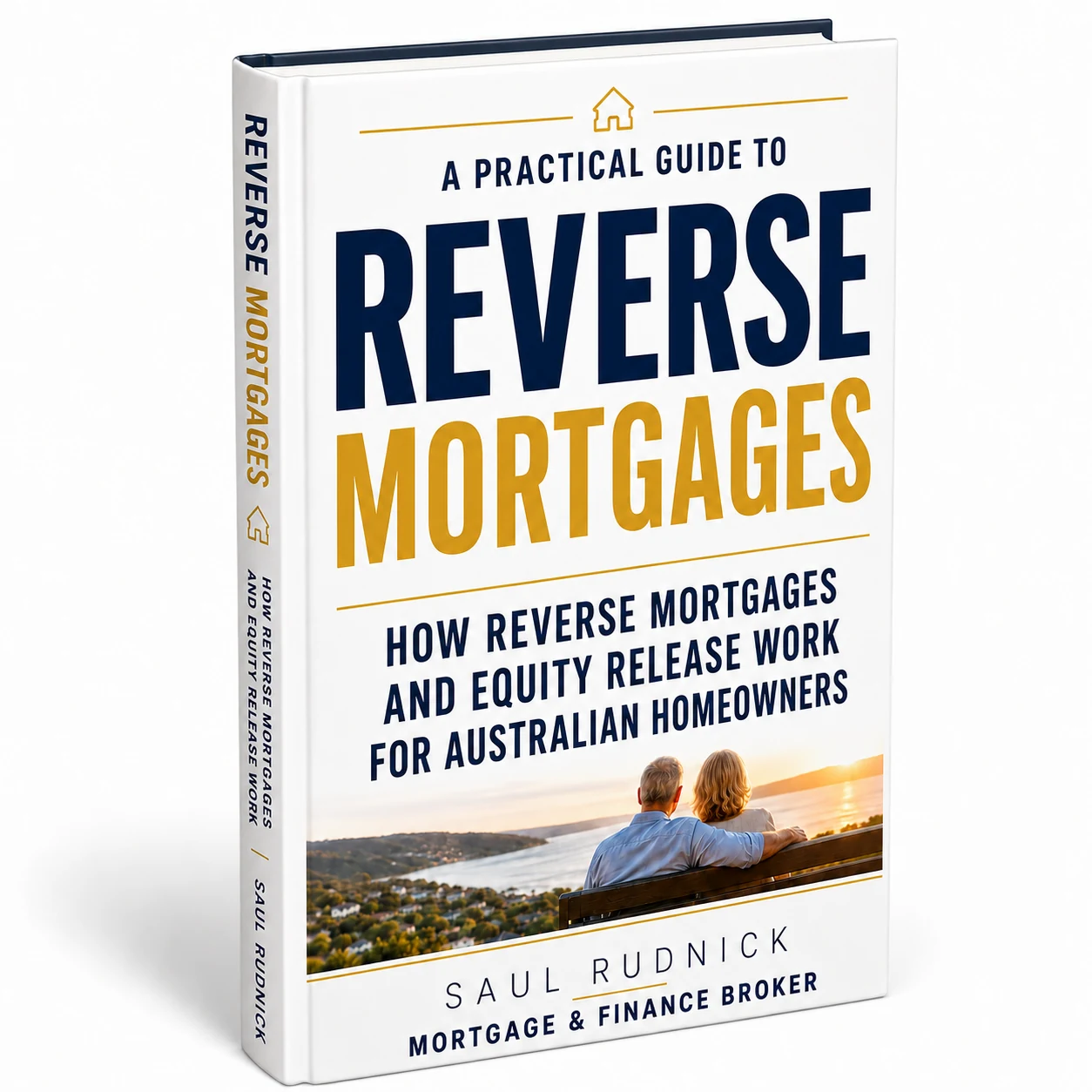
Further Reading
A Practical Guide to Reverse Mortgages explores reverse mortgages, equity release, alternatives, costs, risks, safeguards and practical situations in much greater detail.
The book includes worksheets and detailed visual guides designed to make complex decisions easier to understand.